Radiation Oncology | Analytics | Enterprise
ProKnow
Cloud-Based RT-PACS & Oncology Analytics
Context & Stakes
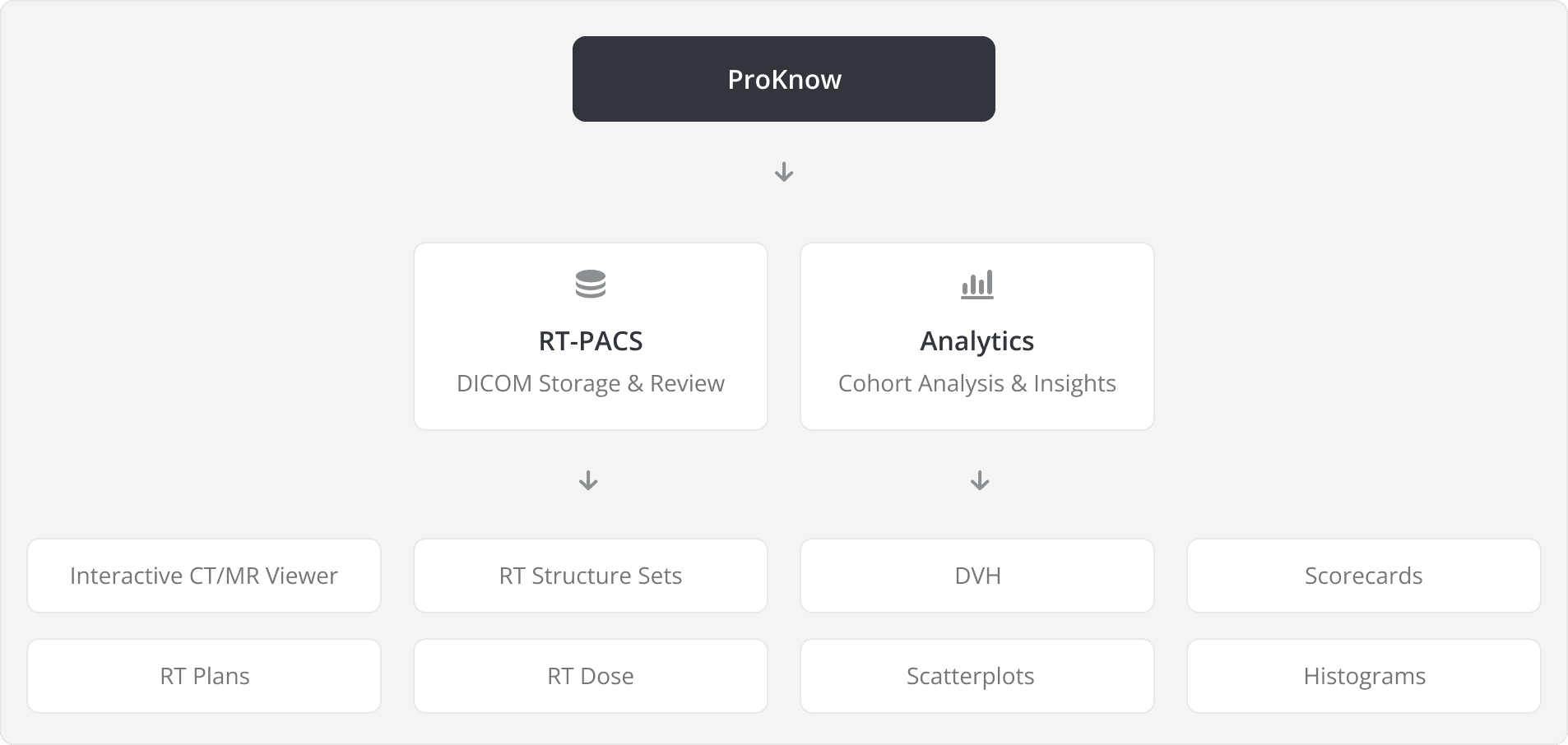
ProKnow is a cloud-based RT-PACS and oncology analytics platform designed to give radiation oncology teams powerful, flexible access to their clinical data — both at the level of individual patients and across large, organized collections (cohorts).
ProKnow provides universal DICOM support for CT and MR imaging, including conventional imaging and on-board IGRT, and specializes in radiotherapy-specific data such as structure sets, treatment plans, and dose distributions. Unlike traditional PACS, ProKnow was built from the ground up to support not just storage and review, but active analysis, exploration, and insight generation across growing datasets.
At the time, this combination of cloud-native architecture, RT-PACS functionality, and advanced analytics tooling represented a meaningful shift in how radiation oncology data could be used.
Why This Mattered
Radiation oncology teams operate in an environment where:
- Data volume is massive and continually growing
- Decisions are time-sensitive and high-stakes
- Confidence in data quality and interpretation is critical
The Problem Space
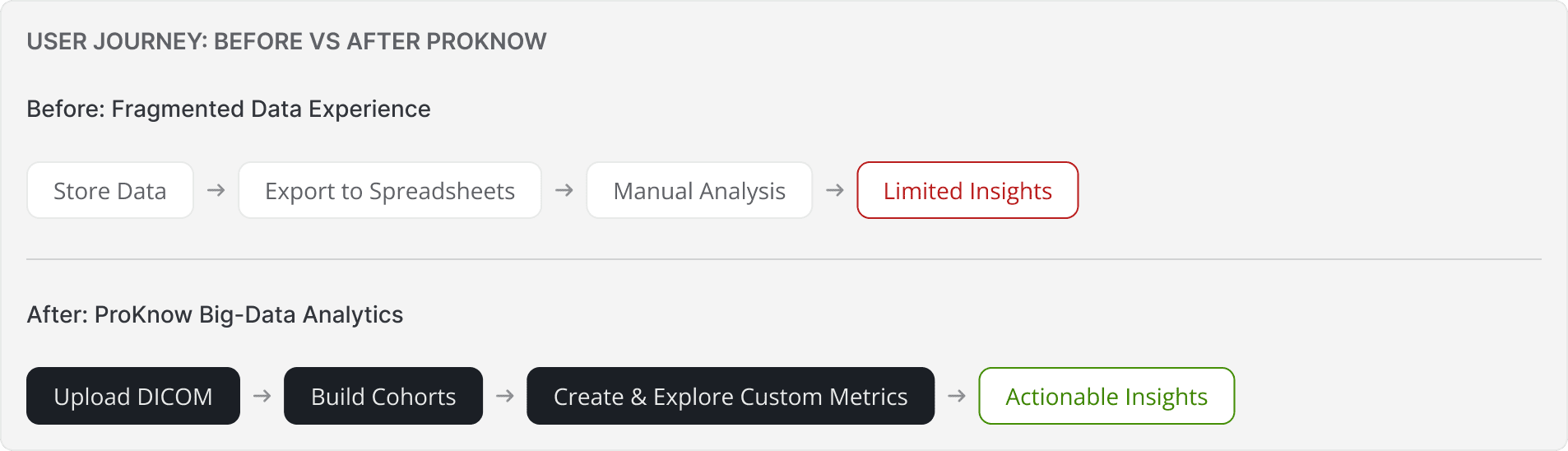
Radiation oncology has long generated vast amounts of complex data, but the industry struggled to realize the practical promise of "big data."
Most organizations could store data, but they lacked tools that made it easy to organize cohorts across time and modalities, feasible to analyze variation and consistency, and possible to move quickly from population-level insight to patient-level detail.
As a result, valuable information remained difficult to explore, compare, or use proactively to improve quality, compliance, and outcomes.
What ProKnow Set Out to Solve
ProKnow addressed this gap by pairing RT-PACS functionality with big-data analytics tools purpose-built for radiation oncology workflows. Key capabilities included:
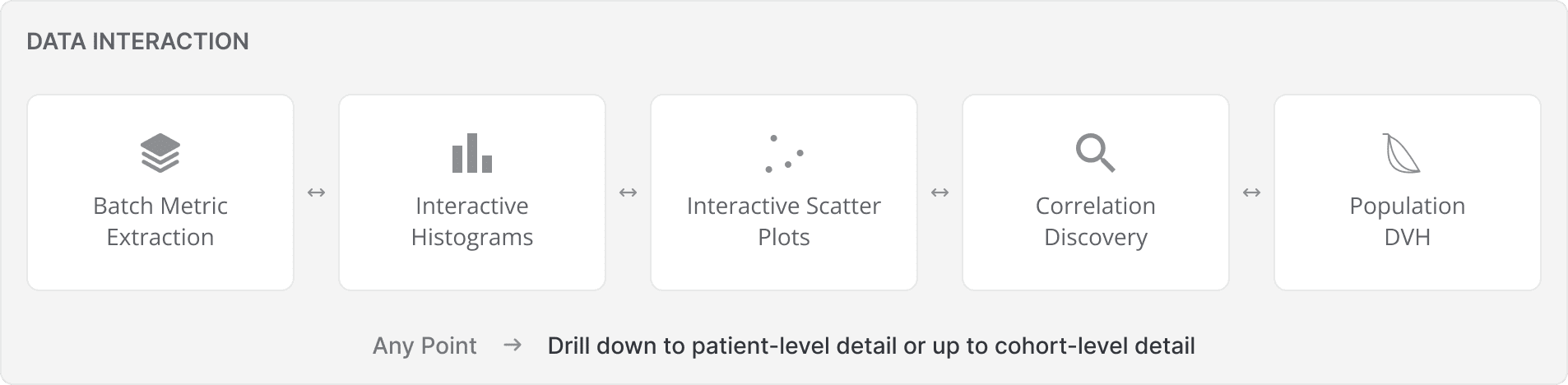
- Batch metric extraction across cohorts to drive consistency and ensure compliance
- Metric histograms to study variation within (or between) cohorts and identify outliers with interactive graphics so you can select a bin to show a patient sub-list and drill down into any patient dataset
- Custom scatter plots to study correlation between your metrics, also with interactive graphics, where dots on the plot are links to specific patient datasets
- Correlation finder that lets ProKnow do the work in computing and sorting the r-values for all metric combinations
- Population DVH showing the statistical spread of DVH curves for any organ or target across all patients in a collection
The challenge was not only technical — it was experiential: How do you make advanced analytics approachable, explorable, and trustworthy for clinicians working with dense, high-risk medical data?
Primary Users
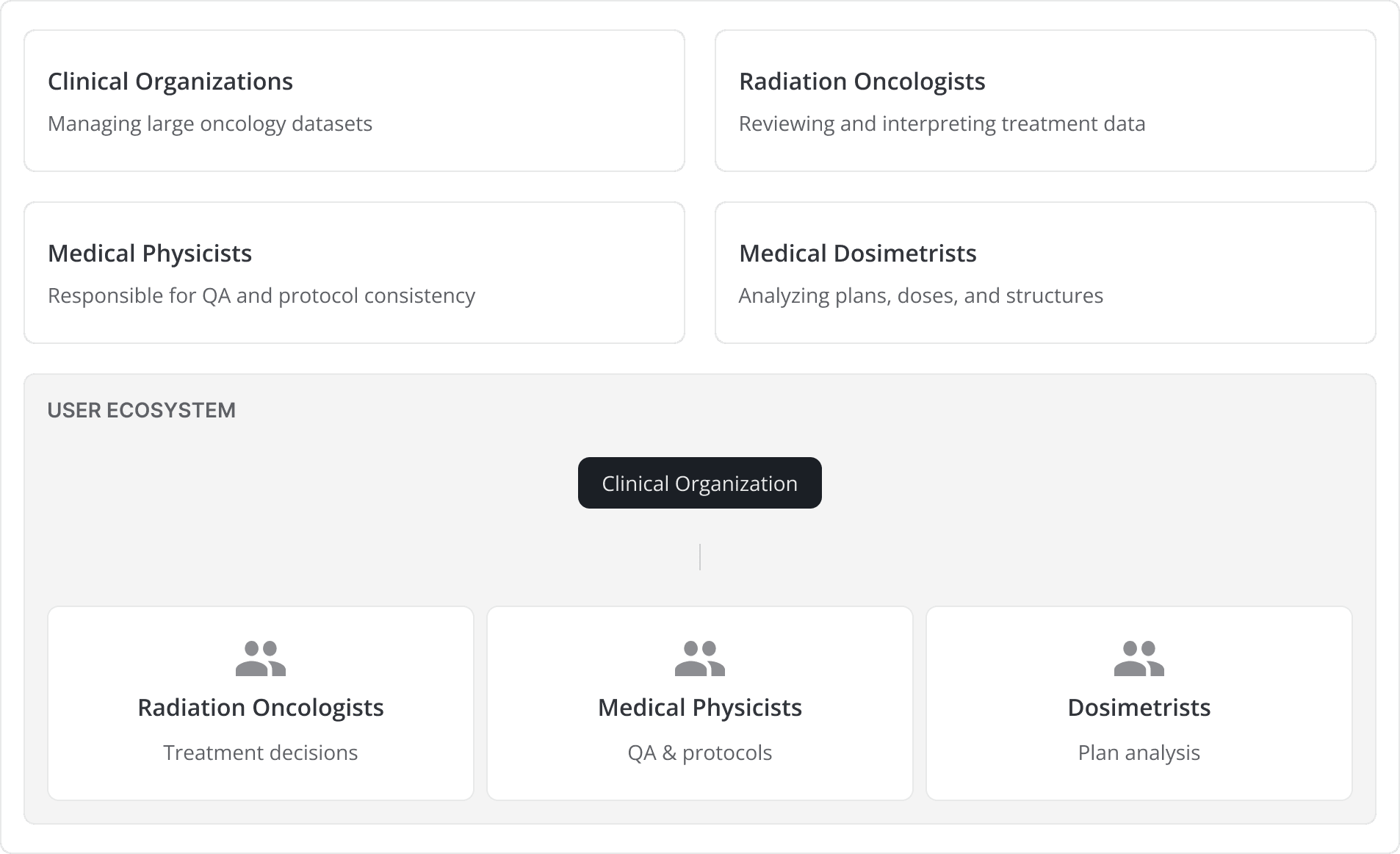
ProKnow was designed for a diverse but interrelated set of users within radiation oncology organizations:
Role & Ownership
I joined the organization that would eventually become ProKnow before ProKnow existed as a product — or even as an idea. I was initially brought in to work on web and UI design for another product within the parent company. As the concept for ProKnow emerged, I became embedded from the earliest possible stage and ultimately owned all design-related work across the company — spanning brand, marketing, product UX, UI systems, and front-end implementation.
In practice, anything related to design — from early concept through production — flowed through me.
Brand, Marketing, and Go-To-Market
- Created all initial branding assets, including logo, theming, and visual identity
- Translated the brand into marketing materials: website, email campaigns, social media, tradeshow assets, and print collateral
- Owned the full design lifecycle from research and concepting through production-ready HTML/CSS and JavaScript
Product UX, Interaction Design, and Systems Thinking
- Participated in and helped shape all initial UX discussions, research, and product planning
- Designed interaction models and workflows for complex oncology analytics and RT-PACS functionality
- Produced wireframes, mockups, and prototypes to support formative testing and iterative design
Design-to-Browser Execution
- Wrote the initial front-end HTML/CSS used by application developers within a custom JavaScript-driven web application
- Designed and implemented all core layouts and UI components
- Established layout systems and tested cross-browser compatibility

Team Context
ProKnow began and functioned as a four-person team: One UX/UI designer/engineer (myself), two exceptional architects/engineers, and one product visionary and medical physicist who also served as the primary content and domain expert. Clear ownership and disciplined collaboration were essential in this environment, and my role sat at the intersection of design strategy, execution, and implementation.
Design Strategy & Key Decisions
Design Philosophy
Speed, clarity, and trust matter more than visual theatrics.
We deliberately chose a clean, flat, and highly legible interface built around simple UI elements. In a data-dense, time-critical clinical environment, anything that slowed the interface or distracted from interpretation carried real cost.
The goal was not to hide complexity — but to organize it so that users could move confidently through demanding workflows without friction or confusion.
What Didn't Work
Early on, we experimented with richer microinteractions and more animated UI behaviors to add polish and perceived responsiveness. In practice, these approaches introduced inconsistency across browsers and operating systems and created moments of visual friction that undermined clarity and speed.
This shift reinforced a key belief: in clinical software, predictability beats decoration.
A Pivotal Decision: Owning the UI System
One of the most consequential design decisions was abandoning Bootstrap in favor of a fully custom, flexbox-driven responsive UI system.
By building our own UI kit and layout system, we gained:
- Precise control over spacing, grids, and responsiveness
- Consistent rendering across environments
- A leaner, more predictable codebase that matched design intent
Result: 80% reduction in CSS bundle size. Eliminated layout bugs across Safari, Firefox, Edge, and Chrome. Enabled precise control over data-dense interfaces.
Interaction & System Design
One of the hardest UX challenges in ProKnow was making cohort-level analytics usable without disconnecting users from individual patients. Radiation oncology analytics requires constant movement between population-level trends, outliers, and instant access to core patient DICOM data.
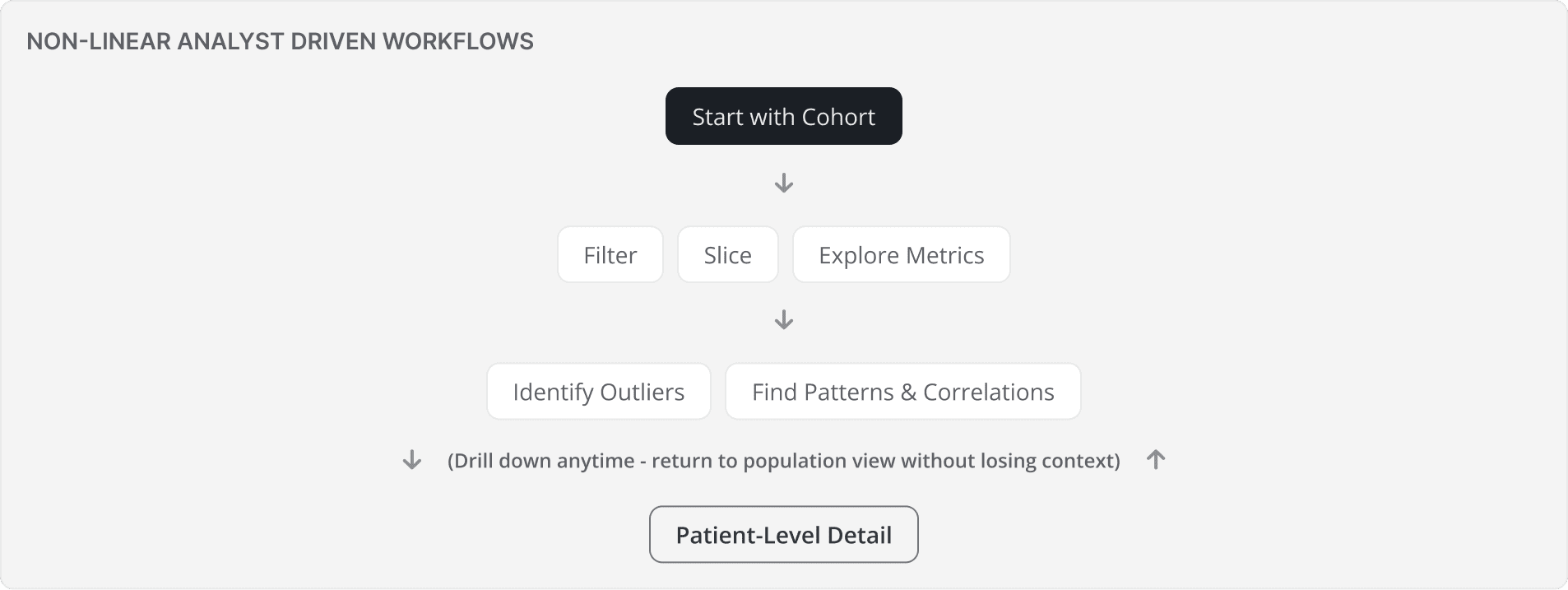
A Non-Linear, Analyst-Driven Interaction Model
Instead of forcing users through a prescribed workflow, ProKnow was intentionally designed to let the analysis drive the workflow. Users could:
- Start with a cohort, filter, slice, and explore metrics
- Identify outliers or patterns
- Drill directly into any patient, toggle studies, plans, structures, or doses
- Return to population-level views without losing context
A Four-Column Interaction Framework
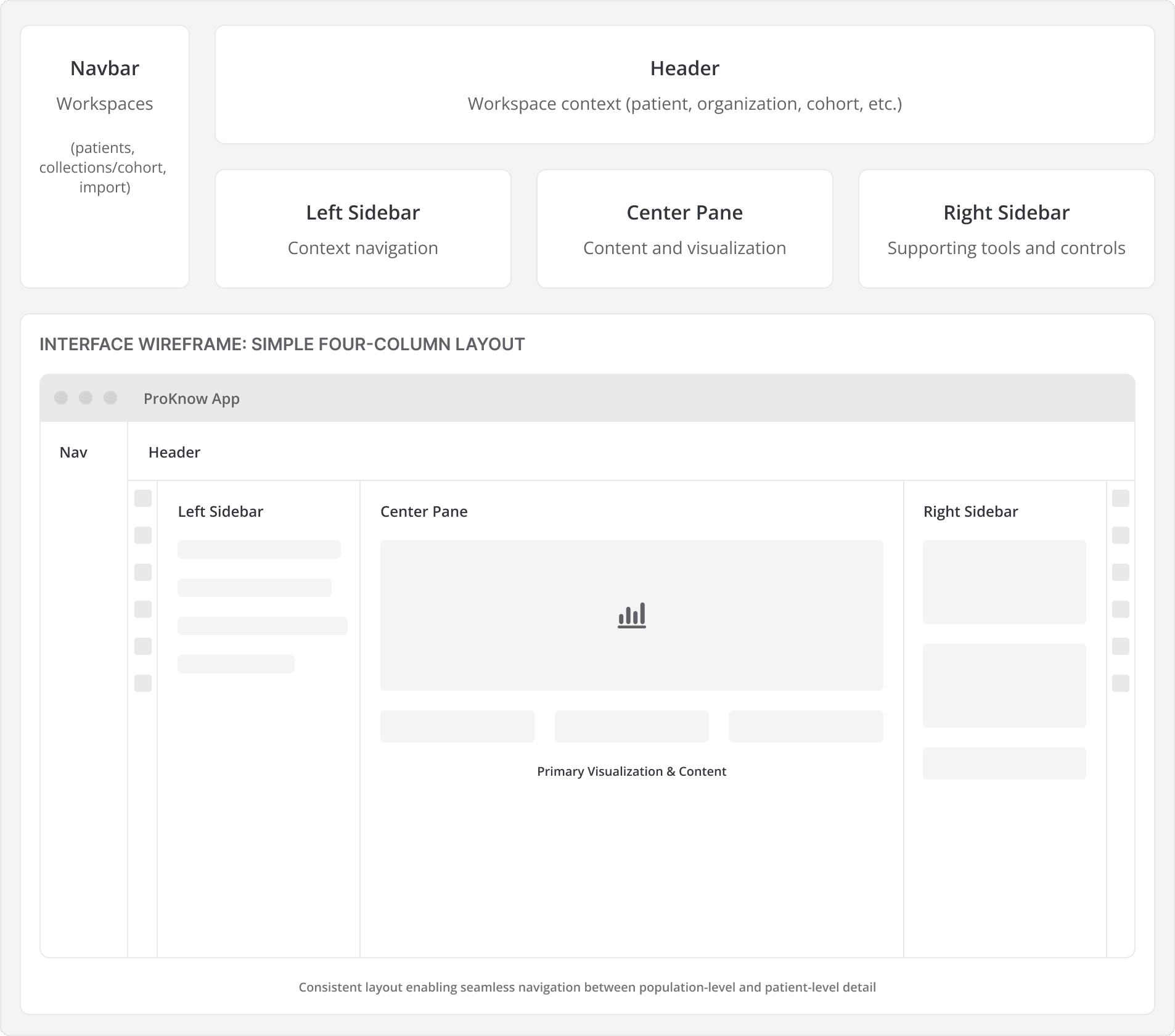
To support this flexibility without overwhelming users, the interface was organized around a simple, consistent four-column layout:
Outcomes & Impact
Global Adoption and Engagement
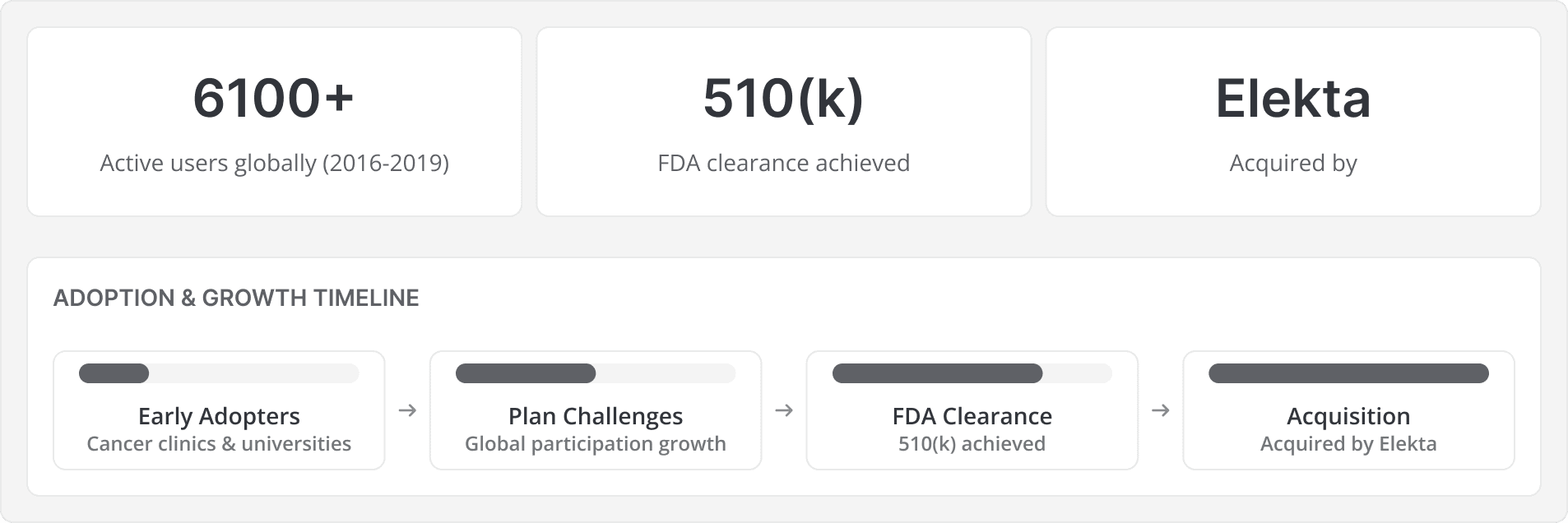
The plan study challenges became a major driver of awareness and engagement. Participation grew steadily year over year, with professionals worldwide submitting plans, competing against gold standards, and reviewing results. Product demos were booked well in advance, and booths were consistently full at major industry tradeshows.
Early Institutional and Academic Adoption
Major cancer clinics engaged early to help test and iterate on features. Universities adopted the Contouring Accuracy Program to train students and improve contouring accuracy. Industry-leading physicians and instructors joined advisory boards, helping guide product direction and validate relevance.
Shifting How the Industry Worked with Data
Feedback consistently centered on the same breakthrough: organizations could load years of historical treatment data into a cloud-based platform, build cohorts, and conduct analytics without relying on fragile spreadsheets. Users described this as a game-changing shift for training, QA, peer review, and collaboration — ultimately improving patient outcomes through data driven planning decisions.
Acquisition by Elekta
By the time ProKnow was acquired, it was no longer just a promising idea — it was becoming a platform with clear market gravity, tackling real-world problems, and clearly growing institutional recognition.
For Elekta, a global leader in radiation therapy technology, this represented more than an acquisition of software. It was an opportunity to integrate a data-driven, cloud-native, analytics-first platform into a much larger ecosystem of clinical tools and customer relationships.
From a product and UX perspective, the acquisition validated a core premise of the work: that modern interaction design, thoughtful UX/UI design, and disciplined system design could change how an entire industry worked with its data.
Reflection & Leadership Takeaways
Customer-Driven Evolution Is Non-Negotiable
No matter how strong a product vision is, customers must ultimately shape what it becomes. Clinicians, physicists, and educators consistently surfaced needs, edge cases, and priorities that could not have been predicted from inside the building. Some of the most meaningful improvements to ProKnow came from listening carefully to those voices.
The Value of Early System Thinking
If I were starting ProKnow again today, one of the biggest changes I would make is to establish a formal design system and pattern library much earlier. That experience has made me far more deliberate about building systems — not just screens — from the onset of all things moving forward.
From Features to Ecosystems
UX cannot be siloed at the feature or service level. Every aspect — workflows, components, and interactions — must be scalable, forward thinking to support an entire ecosystem of products and users in the future. Today's patterns, the tools you build, and the decisions you make, must become tomorrows guiding foundations.
Back to work